
Emission Factors Explained: How to Choose the Right Ones
Emission factors are numerical values that convert a unit of activity data, such as litres of diesel or megawatt-hours of grid electricity, into an estimated quantity of greenhouse gas emissions. Finance teams building a corporate GHG inventory, sustainability managers preparing disclosures, and compliance officers responding to CBAM or CSRD requests all depend on selecting an appropriate factor. Choose the wrong one and every downstream number, from Scope 1 totals to product carbon footprints, inherits that error.
This article works through how emission factors fit into a corporate GHG inventory, the organisational and scope boundaries that determine which factors apply, the calculation controls that protect data quality, and where independent verification enters the picture. It is written for readers who already understand the basics and now need a defensible selection process.
Organisational Boundary and Scope
Before any emission factor is chosen, an organisation must define its organisational boundary and reporting scope. The organisational boundary determines which entities, facilities, joint ventures or subsidiaries are consolidated into the inventory, typically using an equity share or control approach consistent with the GHG Protocol Corporate Standard and ISO 14064-1.
- Equity share consolidation reflects the percentage of economic interest held in an operation.
- Financial control consolidation includes 100% of emissions where the organisation directs financial and operating policies.
- Operational control consolidation includes 100% of emissions where the organisation has authority over operating policy, regardless of ownership percentage.
Only after the organisational boundary is fixed can a team map activity data to the correct facilities and select factors that match the geographic and technological reality of those operations. Getting the boundary wrong means applying the right factor to the wrong set of emission sources, which is a distinct error from choosing a poor factor in the first place.
Scope 1, 2 and 3 Emissions
Once the boundary is set, emissions are classified by scope, and each scope shapes which type of emission factor is relevant.
- Scope 1 covers direct emissions from owned or controlled sources, such as combustion in boilers or company vehicles, typically using fuel-specific factors.
- Scope 2 covers indirect emissions from purchased electricity, heat, steam or cooling, using either location-based grid average factors or market-based supplier and residual mix factors.
- Scope 3 covers all other value chain emissions, from purchased goods and services to downstream use of sold products, drawing on a wide range of secondary and supplier-specific factors described in the Scope 3 calculation guidance.
Scope 2 deserves particular care because the location-based and market-based results can differ substantially depending on the supplier’s residual energy mix. Reporting both figures, as the GHG Protocol Corporate Standard recommends, avoids masking that difference.
Activity Data and Emission Factors
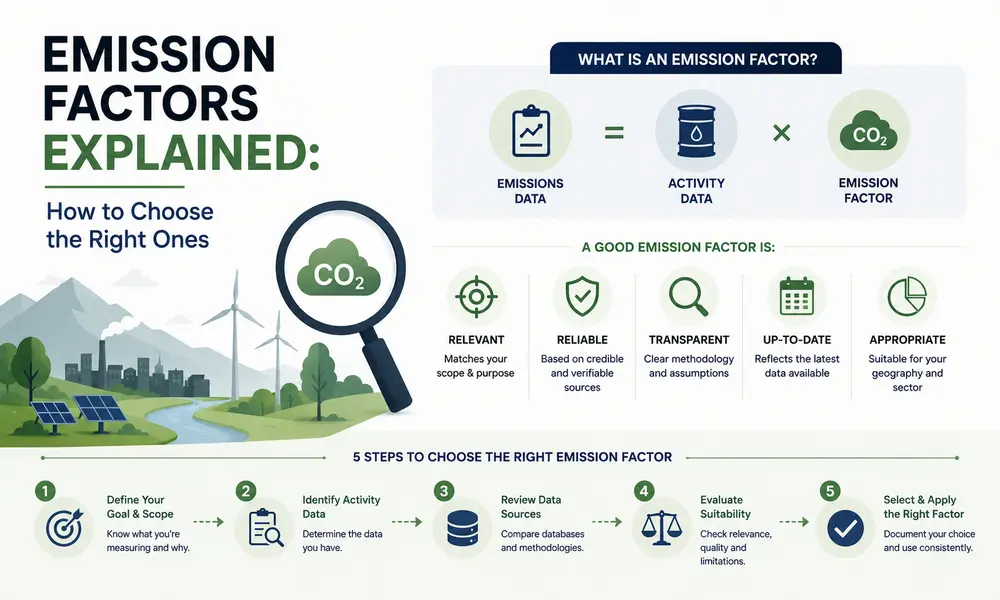
Activity data is the measurable quantity of a business activity, for example litres of fuel purchased, tonnes of material processed or kilometres travelled. An emission factor converts that activity data into greenhouse gas emissions, usually expressed as kilograms or tonnes of CO2 equivalent per unit of activity.
Selecting the right factor means matching four characteristics between the factor and the activity it describes:
- Fuel or material type, including grade, blend or chemical composition.
- Geographic scope, since grid electricity factors vary by country or regional grid.
- Time period, because factors are updated as grids decarbonise or methodologies change.
- Technology or process specificity, distinguishing, for example, blast furnace steel from electric arc furnace steel.
Factors generally fall into two categories: default (or secondary) factors published by governments, IPCC, IEA or industry bodies, and supplier-specific (or primary) factors derived from direct measurement or supplier disclosure. Default factors are faster to apply and useful for materiality screening. Supplier-specific factors are more representative but require more effort to collect and verify, and they matter increasingly for CBAM embedded emissions calculations and product carbon footprint work under ISO 14067.
Calculation Method and Data Controls
A defensible inventory needs documented data controls, not just a spreadsheet formula. Controls establish who sources activity data, who selects factors, and how both are reviewed before publication.
- Identify each emission source and confirm it sits within the defined organisational boundary.
- Collect activity data from meters, invoices, procurement records or supplier declarations.
- Select an emission factor matching the fuel, material, geography and year of the activity.
- Apply the calculation: activity data multiplied by the emission factor, adjusted for global warming potential where relevant.
- Record the factor source, publication year and version for audit purposes.
- Review outputs against prior periods to flag anomalies before finalising the inventory.
Illustrative Worked Example
This example uses simplified, illustrative figures only, not real measured data. A facility reports 10,000 litres of diesel consumed in Scope 1, with an illustrative emission factor of 2.68 kg CO2e per litre. The calculation is 10,000 × 2.68 = 26,800 kg CO2e, or 26.8 tonnes CO2e. If the facility instead used a generic average factor of 2.5 kg CO2e per litre, the result would understate emissions by roughly 720 kg CO2e, a variance entirely attributable to factor selection rather than activity data error.
How GHG Inventories Support CSRD and ESRS E1 Disclosures
For undertakings within the applicable scope of the CSRD, Directive (EU) 2022/2464, as amended by Directive (EU) 2026/470, a GHG inventory built on sound activity data and appropriately chosen emission factors can support ESRS E1 climate disclosures, where those disclosures are applicable and material to the undertaking. The inventory itself is not a CSRD deliverable; it is the underlying dataset that feeds the climate change disclosures required under the European Sustainability Reporting Standards, available via EUR-Lex.
Separately, the resulting GHG statement, once compiled to ISO 14064-1, may be independently verified under ISO 14064-3. Verification of the statement confirms the numbers were prepared consistently with the standard; it does not certify the organisation, its management system, or any carbon neutrality claim. These are two distinct outputs from the same underlying dataset, and readers should not treat CSRD-aligned disclosure and ISO 14064-3 verification as interchangeable steps.
Verification and Assurance
Verification tests whether the reported GHG statement is materially correct against a defined standard. Under ISO 14064-1, an organisation prepares the inventory; under ISO 14064-3, an independent verifier assesses it. Zero Emissions Hub prepares GHG inventories and supporting documentation but does not act as an accredited verification body; verification is performed by third-party verifiers, consistent with ISO 14065 requirements for validation and verification bodies. More detail on that separation of roles is available on our ISO 14065 validators page.
Assurance levels also matter for CSRD-linked disclosures, where limited assurance is currently the expected starting point for sustainability information under the relevant EU requirements, detailed further at eur-lex.europa.eu.
Common Mistakes in Practice
- Applying a national average grid factor when a supplier-specific or residual mix factor is available and more representative.
- Using an outdated factor published several years before the reporting period without checking for updates.
- Mixing factors from different sources within the same inventory without documenting methodology consistency.
- Confusing organisational boundary consolidation approaches partway through a reporting year.
- Treating a Scope 2 market-based figure as the only relevant number and omitting the location-based comparison.
- Applying a generic industry factor to a product carbon footprint calculation that requires process-specific data under ISO 14067.
- Failing to record the factor version and source, which undermines any later verification under ISO 14064-3.
How We Work and What You Receive
Zero Emissions Hub supports finance, sustainability and compliance teams in building GHG inventories aligned with ISO 14064-1 and the GHG Protocol Corporate Standard. Our work typically includes organisational boundary reviews, activity data collection frameworks, emission factor selection matched to geography and technology, and documentation ready for third-party verification.
Clients typically receive a structured GHG inventory, an emission factor register with sources and versions, a data control note describing calculation methodology, and recommendations for closing data gaps ahead of CSRD or CBAM reporting cycles. These outputs connect directly to our broader carbon accounting services and ESG reporting support, and where relevant to ISO standards implementation work. Teams comparing packaged options can also review our carbon accounting and ESG reporting package.
Frequently Asked Questions
What is the difference between activity data and an emission factor?
Activity data is the measured quantity of an activity, such as fuel purchased. The emission factor is the conversion value applied to that quantity to estimate emissions.
Should we always use supplier-specific emission factors?
Supplier-specific factors are generally more representative, but default factors from recognised sources remain valid for materiality screening and early-stage inventories, particularly under time or data constraints.
Does using ISO 14064-1 automatically certify our organisation?
No. ISO 14064-1 is a specification for quantifying and reporting emissions. It does not certify an organisation, and any verification of the resulting GHG statement is performed separately under ISO 14064-3.
How often should emission factors be reviewed?
Factors should be reviewed at least annually, since grid mixes, fuel blends and published datasets change. Reviewing factor versions is part of a sound data control process.
Can the same GHG inventory serve both CSRD and CBAM purposes?
The underlying activity data and factor selection principles overlap, but CBAM embedded emissions calculations follow their own methodology under Regulation (EU) 2023/956, so outputs should not be assumed interchangeable without review, referenced at taxation-customs.ec.europa.eu.
Request a Carbon Accounting Assessment
If your team needs help selecting defensible emission factors, structuring activity data, or preparing a GHG inventory ready for CSRD, CBAM or ISO 14064-3 verification, our advisers can review your current approach. Contact Zero Emissions Hub to request an assessment or call +359 889 537 131 to discuss your inventory scope.
Find More Similar Articles
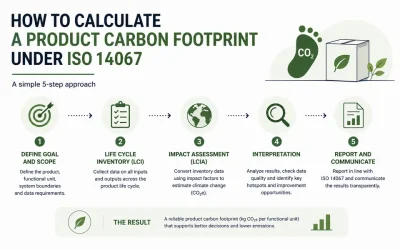
How to Calculate a Product Carbon Footprint under ISO 14067
How to calculate product carbon footprint is a question finance and sustainability teams increasingly ask together, not separately. A product carbon footprint (PCF) quantifies the greenhouse gas emissions associated with…
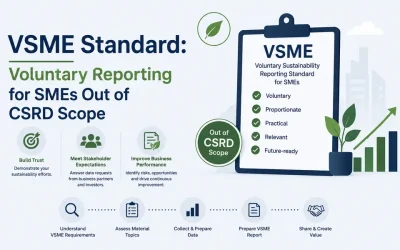
VSME Standard: Voluntary Reporting for SMEs Out of CSRD Scope
VSME standard refers to the Voluntary Sustainability Reporting Standard for SMEs, a proportionate framework companies can use when they fall outside mandatory CSRD scope. Since Directive (EU) 2026/470 narrowed the…
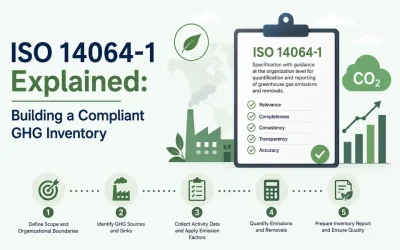
ISO 14064-1 Explained: Building a Compliant GHG Inventory
ISO 14064-1 is an international specification that sets out principles and requirements for quantifying and reporting an organisation’s greenhouse gas emissions and removals. It gives finance, sustainability and compliance teams…
Need practical sustainability guidance?
Talk to Zero Emissions Hub about carbon accounting, ESG reporting, CBAM and climate compliance support.