
VSME Standard: Voluntary Reporting for SMEs Out of CSRD Scope
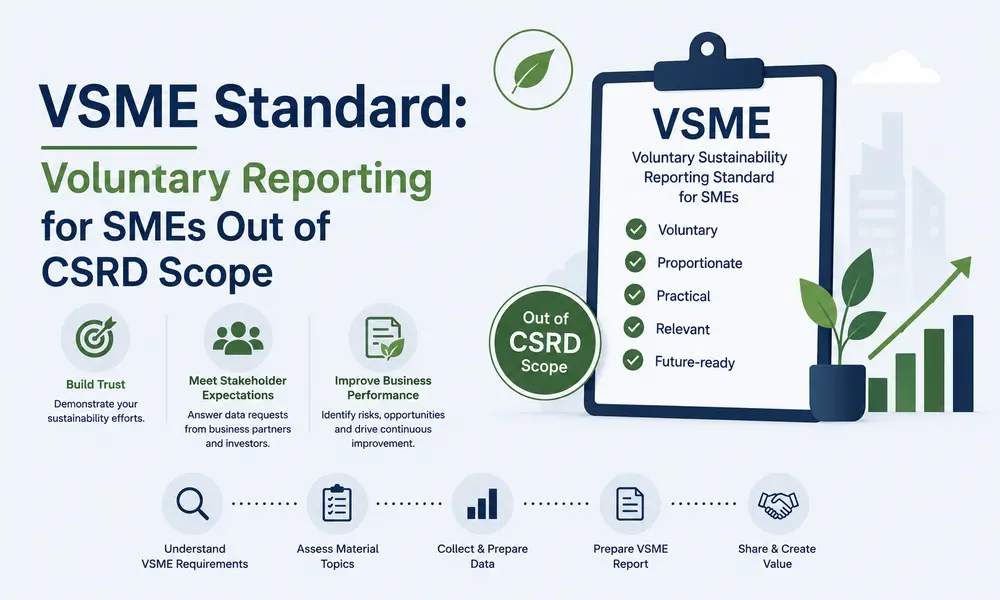
VSME standard refers to the Voluntary Sustainability Reporting Standard for SMEs, a proportionate framework companies can use when they fall outside mandatory CSRD scope. Since Directive (EU) 2026/470 narrowed the mandatory reporting population, thousands of businesses across the EU have moved from “in scope” to “out of scope.” This article explains exactly where that new threshold sits, how it applies to groups and non-EU parents, and why voluntary reporting through the VSME framework still matters commercially, even without a legal obligation.
The New CSRD Threshold for EU Companies
For financial years starting on or after 1 January 2027, an EU undertaking sits within mandatory CSRD reporting scope only if it exceeds both a net turnover of €450 million and an average of more than 1,000 employees during the financial year. This is a cumulative AND test, not the former two-out-of-three size criteria that also included balance-sheet total. Missing either threshold takes a company out of mandatory scope, even if the other figure is well above the line.
- Calculate average employee headcount across the financial year, not a single reporting-date snapshot.
- Calculate net turnover using the accounting definition applied in statutory financial statements.
- Confirm both figures exceed the respective thresholds; if only one does, mandatory scope does not apply.
- Check national transposition, since some Member States may apply exemptions for financial years beginning between 1 January 2025 and 31 December 2026.
Our earlier analysis on the CSRD scope threshold data requirements walks through the practical data-gathering steps finance teams need to confirm their position.
How the Threshold Applies to Consolidated Groups
Where a parent undertaking prepares consolidated financial statements, the same €450 million turnover and 1,000-employee conditions apply on a consolidated basis. This means the test looks at group-wide figures, not the standalone accounts of the parent entity alone. A parent with modest solo turnover can still be caught if its consolidated group exceeds both thresholds. Subsidiaries below the threshold individually may still be swept into scope through the group’s consolidated reporting obligation, so group finance teams need visibility across all entities before concluding on scope.
The Test for Non-EU Parent Companies
Third-country groups face a distinct test. A third-country undertaking or group falls into scope when it generates more than €450 million net turnover in the EU for each of the last two consecutive financial years. That condition must be combined with a qualifying EU subsidiary or branch exceeding €200 million net turnover in the preceding financial year. Both conditions must be met together; a large global group with only a small EU footprint, or an EU subsidiary that individually clears €200 million but whose parent group’s EU turnover stays below €450 million, will not trigger mandatory reporting under this route. Non-EU exporters supplying EU steel, aluminium, cement, fertiliser, electricity or hydrogen supply chains should assess this test alongside their CBAM obligations, since the two regimes track different boundaries.
Are Listed SMEs Still in Scope?
Listed SMEs are no longer part of mandatory CSRD sustainability reporting under the amended scope. This is a permanent removal from the mandatory population, not a delayed compliance wave or a temporary opt-out. Listed SMEs that previously prepared for phased-in reporting should revisit their compliance calendars, since resources originally allocated to mandatory ESRS reporting may now be better directed toward voluntary disclosure aligned with market or lender expectations.
When the Amended Rules Apply
The amended thresholds apply for financial years starting on or after 1 January 2027. For financial years beginning between 1 January 2025 and 31 December 2026, Member States may exempt undertakings and issuers below either new threshold, but this is discretionary rather than automatic. Companies should check the relevant national transposition instrument rather than assume uniform treatment across the EU. National transposition is due by 19 March 2027, and the European Commission maintains updated guidance on its corporate sustainability reporting page.
CSRD Scope Decision Tree
- Is your company a third-country undertaking or part of a third-country group? If yes, apply the €450 million EU turnover and €200 million subsidiary test.
- If EU-based, does your company prepare consolidated financial statements? If yes, apply thresholds on a consolidated basis.
- Does turnover exceed €450 million AND average employees exceed 1,000? Both conditions must be true for mandatory scope.
- Is your company a listed SME? If so, mandatory reporting no longer applies regardless of other factors.
- Does your financial year start before 1 January 2027? Check national transposition for possible transitional exemption.
- If out of scope on every test, consider voluntary reporting, including VSME-aligned disclosure.
Worked Examples
These figures are illustrative only, intended to demonstrate the mechanics of the test, not real client data.
- Company A: €520 million turnover, 850 average employees. Turnover exceeds €450 million but employees stay below 1,000. Not in mandatory scope, since both conditions are not met.
- Company B: €300 million turnover, 1,400 average employees. Employees exceed 1,000 but turnover is below €450 million. Not in mandatory scope.
- Company C: €600 million consolidated turnover, 1,250 average consolidated employees. Both thresholds exceeded on a consolidated basis. In mandatory scope.
- Company D: A third-country group with €480 million EU turnover for two consecutive years and an EU subsidiary reporting €210 million turnover. Both conditions met. In mandatory scope under the third-country test.
The Ontology Bridge: Voluntary Reporting and Commercial Data Requests
Falling outside mandatory CSRD scope does not remove all reporting pressure. Companies out of scope may still choose voluntary sustainability reporting, including VSME-related disclosure, to satisfy lenders, investors or customers. Larger customers still in mandatory scope often send proportionate value-chain data requests to their suppliers, asking for emissions or governance data to complete their own Scope 3 or ESRS disclosures. These requests are commercial in nature and should never be confused with a legal CSRD reporting obligation. A supplier can respond helpfully to a customer’s data request using a VSME-aligned template without becoming subject to CSRD itself. Distinguishing these two dynamics avoids both under-reaction and unnecessary over-compliance.
What If Your Company Is Now Out of Scope?
Being out of mandatory scope does not mean sustainability data becomes irrelevant. Many SMEs choose to maintain a lighter, VSME-aligned disclosure to preserve access to green financing, tenders and supply-chain relationships. A basic voluntary report typically covers energy use, workforce data, governance policies and, where relevant, a simplified emissions overview. This is a proportionate alternative to full ESRS reporting and avoids duplicating work that mandatory-scope companies must perform under double materiality requirements.
What to Do If You Remain in Scope
Companies confirmed in mandatory scope move into a different, more detailed workstream. Double materiality assessment, ESRS topic mapping, data governance controls and preparation for limited assurance all become relevant. The obligation to move toward reasonable assurance was removed under the amending directive; CSRD sustainability reporting remains subject to limited assurance only, with the deadline for EU limited-assurance standards set at 1 July 2027. Reporting frameworks referenced during ESRS implementation often draw on complementary standards, including GRI Standards, ISSB Standards and SBTi Standards for target-setting alignment. Further detail on ESRS structure sits on our dedicated ESRS Standards page, and background on ISSB compatibility is available through the IFRS Sustainability Standards Navigator.
How We Work and What You Receive
Zero Emissions Hub supports both companies confirming their CSRD position and those preparing voluntary VSME-aligned reports. Our team, based in Sofia with offices in Plovdiv and Varna, combines environmental science, finance and engineering backgrounds built over more than a decade of carbon accounting and ESG advisory work.
- A scope assessment mapping your turnover, employee data and group structure against the amended thresholds.
- A documented scope determination memo suitable for audit and board reporting purposes.
- Where out of scope, a proportionate VSME-aligned reporting template covering energy, workforce and governance data.
- Where in scope, a double materiality assessment and ESRS topic gap analysis.
- Guidance on responding to value-chain data requests from customers without overstating your compliance position.
We are consultants, not an accredited verification body. Independent verification, where required, is carried out separately by third-party verifiers. Related services are outlined on our ESG Reporting and Package Service pages, and ISO-aligned inventory work is described under ISO Standards implementation.
Common Mistakes When Assessing Scope
- Using headcount at a single reporting date instead of the average across the financial year.
- Applying standalone figures for a parent instead of the consolidated basis required by group rules.
- Assuming national transposition is identical across Member States, without checking local exemptions.
- Treating a customer’s value-chain data request as proof of a legal CSRD obligation.
- Continuing to prepare for reasonable assurance despite the removal of that requirement in favour of limited assurance.
Frequently Asked Questions
What is the VSME standard used for?
The VSME standard gives SMEs a proportionate, voluntary framework to disclose sustainability information, often in response to lender or customer requests, without adopting full mandatory CSRD reporting.
Does the €450 million threshold apply to standalone or consolidated accounts?
It applies to standalone accounts for individual EU undertakings, and on a consolidated basis for qualifying parent undertakings preparing group accounts.
Are listed SMEs required to report under CSRD at all?
Listed SMEs are no longer subject to mandatory CSRD sustainability reporting under the amended scope introduced by Directive (EU) 2026/470.
Does a customer’s ESG questionnaire mean my company is in CSRD scope?
No. A value-chain data request from a customer is a commercial request, not evidence of a legal CSRD reporting obligation for your company.
When do the new thresholds take legal effect?
The thresholds apply for financial years starting on or after 1 January 2027, with national transposition due by 19 March 2027, subject to Member State detail.
Is CSRD reporting subject to full audit-level assurance?
No. The requirement to move toward reasonable assurance was removed; CSRD reporting remains subject to limited assurance, with EU assurance standards due by 1 July 2027.
Request an Assessment
If you need clarity on where your company sits under the new CSRD scope threshold, or want a proportionate VSME-aligned reporting approach, our team can help. Contact Zero Emissions Hub to request a scope assessment or call +359 889 537 131 to discuss your position with an adviser.
Find More Similar Articles
How to Calculate a Product Carbon Footprint under ISO 14067
How to calculate product carbon footprint is a question finance and sustainability teams increasingly ask together, not separately. A product carbon footprint (PCF) quantifies the greenhouse gas emissions associated with…
Emission Factors Explained: How to Choose the Right Ones
Emission factors are numerical values that convert a unit of activity data, such as litres of diesel or megawatt-hours of grid electricity, into an estimated quantity of greenhouse gas emissions….
ISO 14064-1 Explained: Building a Compliant GHG Inventory
ISO 14064-1 is an international specification that sets out principles and requirements for quantifying and reporting an organisation’s greenhouse gas emissions and removals. It gives finance, sustainability and compliance teams…
Need practical sustainability guidance?
Talk to Zero Emissions Hub about carbon accounting, ESG reporting, CBAM and climate compliance support.