
ISO 14064-1 Explained: Building a Compliant GHG Inventory
ISO 14064-1 is an international specification that sets out principles and requirements for quantifying and reporting an organisation’s greenhouse gas emissions and removals. It gives finance, sustainability and compliance teams a structured method for building a corporate GHG inventory that can withstand scrutiny from auditors, customers and regulators. For companies preparing disclosures under CSRD or responding to procurement questionnaires, a well-built inventory is the foundation everything else depends on.
This article is written for finance teams, sustainability managers and compliance officers who need to understand how ISO 14064-1 works in practice, not just what it says on paper. We focus on how the standard structures a GHG inventory, where organisations commonly go wrong, and how verification under ISO 14064-3 fits into the broader reporting picture.
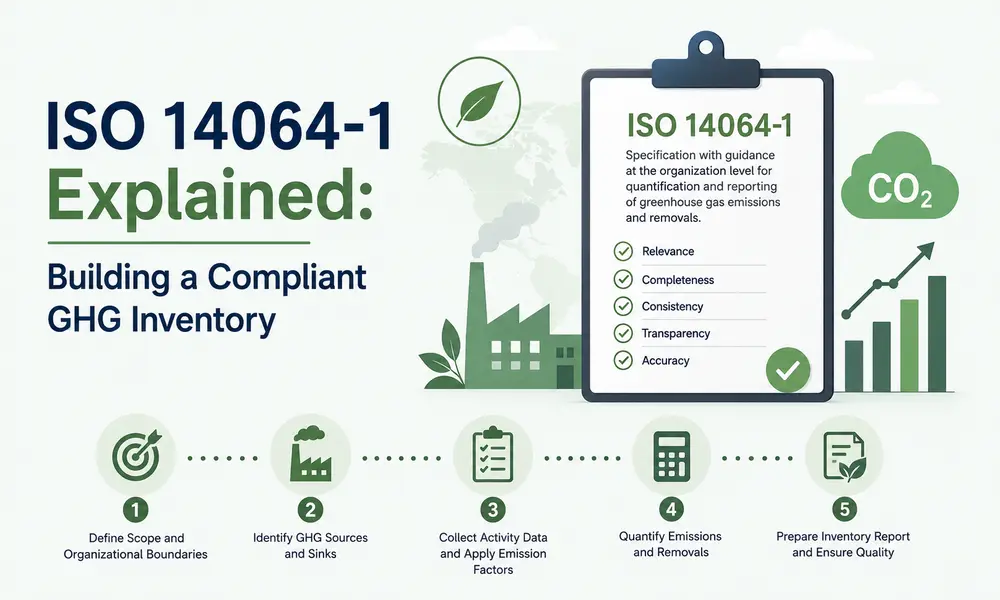
ISO 14064-1: Organisational Boundary and Scope
Before any emissions data can be gathered, an organisation must define its organisational boundary. This determines which facilities, subsidiaries, joint ventures and operations are included in the inventory. ISO 14064-1 permits two consolidation approaches: the equity share approach, where emissions are apportioned according to ownership percentage, and the control approach, using either financial or operational control.
The choice of consolidation approach affects which entities appear in the inventory and how emissions are attributed across a corporate group. Organisations with joint ventures or minority stakes need to document their chosen approach clearly, since switching methods later can create inconsistencies in year-on-year comparisons. Our guidance on managing greenhouse gas boundaries covers this decision in more depth for groups with complex ownership structures.
Scope 1, 2 and 3 Emissions
ISO 14064-1 itself categorises emissions as direct and indirect, rather than using Scope 1, Scope 2 and Scope 3 as native terminology. However, the GHG Protocol’s scope mapping is widely used alongside ISO 14064-1 to help readers interpret results, and we use it here for clarity.
- Direct emissions occur from sources owned or controlled by the organisation, commonly referred to as Scope 1 — combustion in owned boilers, vehicles or process equipment.
- Indirect emissions from imported energy, commonly referred to as Scope 2, arise from purchased electricity, heat, steam or cooling.
- Other indirect emissions, commonly referred to as Scope 3, occur in the value chain — purchased goods, transport, business travel, use of sold products and more.
Under ISO 14064-1, an organisation must identify indirect-emission categories relevant to its operations, establish and document criteria for evaluating their significance, include significant categories in the inventory, and justify any exclusions. This is a more rigorous requirement than simply treating indirect emissions as optional. A lack of primary supplier data does not, on its own, justify leaving out a significant category; the standard expects transparent estimation, documented data quality and a plan to improve data over time.
Activity Data and Emission Factors
Every emissions calculation rests on two inputs: activity data and an emission factor. Activity data describes a measurable quantity — litres of fuel burned, kilowatt-hours consumed, tonnes of material purchased. The emission factor converts that activity into greenhouse gas mass, typically expressed as tonnes of CO2 equivalent per unit of activity.
Selecting the right emission factor matters as much as collecting accurate activity data. Supplier-specific factors are generally preferred where available, followed by national or regional grid factors, and finally generic industry averages as a last resort. Mixing factor sources across reporting periods without documentation is a common source of inconsistency that undermines year-on-year comparability. The GHG Protocol Scope 3 calculation guidance offers useful reference methods for indirect categories where primary data is limited.
Calculation Method and Data Controls
A defensible GHG inventory follows a consistent, repeatable calculation process. The steps below outline the typical sequence our advisory team follows when building an inventory aligned with 14064-1.
- Define the organisational boundary using either the equity share or control approach, and document the rationale.
- Identify all relevant emission sources and sinks across direct and indirect categories.
- Collect activity data from meters, invoices, procurement records or supplier disclosures.
- Select appropriate emission factors, prioritising supplier-specific data where it exists.
- Apply the calculation methodology consistently across all sources and periods.
- Assess data quality and uncertainty for each category, flagging estimates versus measured values.
- Compile the GHG statement with supporting documentation for each figure.
- Establish a data-improvement plan for categories with weak primary data coverage.
Robust data controls include version-controlled spreadsheets or dedicated software, named data owners for each source, and a documented audit trail linking every figure back to its source record. Weak controls are the single most frequent reason inventories fail internal review before external verification even begins.
Worked Example: Calculating a Single Emission Source
The following figures are illustrative only and do not represent real client data. Consider a company reporting Scope 1 emissions from a fleet of delivery vans.
- Activity data: 40,000 litres of diesel consumed during the reporting year.
- Emission factor: 2.68 kg CO2e per litre of diesel (illustrative value).
- Calculation: 40,000 litres × 2.68 kg CO2e = 107,200 kg CO2e.
- Converted to tonnes: 107.2 tonnes CO2e for this source.
This same arithmetic pattern — activity data multiplied by an emission factor — applies across virtually every category, from purchased electricity to business travel, though the units and factor sources will differ.
Verification and Assurance
A GHG statement prepared under 14064-1 may be independently verified under ISO 14064-3. Verification is a distinct activity carried out by an accredited third party, assessing whether the statement is materially correct and prepared in line with the stated criteria. Zero Emissions Hub is not an accredited verification body; we prepare inventories and supporting documentation, while verification itself is performed by independent verifiers.
It is worth distinguishing verification of a GHG statement from certification of an organisation or a claim of carbon neutrality. ISO 14064-3 verification confirms the accuracy of reported figures; it does not certify the organisation’s management system, nor does it validate any carbon neutral claim. Bodies performing this work typically operate under accreditation frameworks described in our overview of bodies validating carbon emissions.
Where a GHG Inventory Connects to CSRD Disclosure
For undertakings within the applicable scope of the CSRD, Directive (EU) 2022/2464, as amended by Directive (EU) 2026/470, a GHG inventory built under 14064-1 can support ESRS E1 climate disclosures where those disclosures are applicable and material to the undertaking. The inventory does not automatically satisfy every ESRS E1 data point; double materiality assessment and additional narrative disclosures are still required. Readers can review the CSRD text directly on EUR-Lex and consult the European Commission’s ESRS guidance on ec.europa.eu for scope and applicability details.
Separately, the resulting GHG statement may be independently verified under ISO 14064-3, providing an assurance layer that can support the credibility of figures disclosed under ESRS E1, subject to the assurance requirements that apply to the undertaking.
Common Mistakes in Practice
- Treating indirect emissions as entirely optional rather than assessing significance systematically.
- Switching consolidation approaches between reporting years without documenting the change.
- Using outdated or mismatched emission factors across different facilities in the same inventory.
- Excluding a significant category solely because primary data is unavailable, without attempting estimation.
- Failing to record data quality and uncertainty alongside reported figures.
- Confusing verification of a GHG statement with certification of the organisation itself.
- Assuming an ISO 14064-1 inventory alone satisfies every CSRD or ESRS E1 requirement.
How We Work and What You Receive
Our approach follows the GHG Protocol Corporate Standard and ISO 14064-1 principles side by side, since the two frameworks are closely aligned but not identical in structure. Clients typically receive a documented organisational boundary, a categorised emissions inventory, activity data and emission factor sources, an uncertainty assessment, and a verification-ready GHG statement.
Where clients also need product-level figures, we distinguish organisational inventories from product carbon footprint work under ISO 14067, and from circular economy considerations addressed separately under ISO 59004. For organisations pursuing reduction claims backed by carbon credits, our related guidance on emissions reductions reporting explains how project-level accounting differs from corporate inventories. Broader ISO standards implementation support and our core carbon accounting services cover the full inventory lifecycle, and additional certification-related preparation is available through our certification services page. Further reading is available on our carbon accounting and ESG reporting blog.
Frequently Asked Questions
Is ISO 14064-1 the same as the GHG Protocol Corporate Standard?
No. Both frameworks are closely aligned and use similar principles, but they are distinct documents. The GHG Protocol Corporate Standard is a widely adopted accounting framework, while ISO 14064-1 is a formal international specification with its own structure and terminology.
Does ISO 14064-1 certify a company as carbon neutral?
No. ISO 14064-1 supports quantification and reporting of a GHG inventory. It does not certify carbon neutrality, and Zero Emissions Hub does not make carbon neutral claims on behalf of clients.
Can Scope 3 categories be excluded if data is unavailable?
Not automatically. The standard requires organisations to assess significance, attempt estimation where primary data is missing, and document justified exclusions rather than omitting categories by default.
Who performs verification of a GHG statement?
Verification under ISO 14064-3 is performed by independent, accredited third-party verifiers, not by the consultancy preparing the inventory. Zero Emissions Hub prepares inventories and documentation; verification is a separate, independent step.
Request a GHG Inventory Assessment
If your organisation needs a defensible, verification-ready GHG inventory built on ISO 14064-1 principles, our team can review your current data and boundaries. Contact us to request an assessment or call +359 889 537 131 to discuss your reporting timeline.
Find More Similar Articles
How to Calculate a Product Carbon Footprint under ISO 14067
How to calculate product carbon footprint is a question finance and sustainability teams increasingly ask together, not separately. A product carbon footprint (PCF) quantifies the greenhouse gas emissions associated with…
Emission Factors Explained: How to Choose the Right Ones
Emission factors are numerical values that convert a unit of activity data, such as litres of diesel or megawatt-hours of grid electricity, into an estimated quantity of greenhouse gas emissions….
VSME Standard: Voluntary Reporting for SMEs Out of CSRD Scope
VSME standard refers to the Voluntary Sustainability Reporting Standard for SMEs, a proportionate framework companies can use when they fall outside mandatory CSRD scope. Since Directive (EU) 2026/470 narrowed the…
Need practical sustainability guidance?
Talk to Zero Emissions Hub about carbon accounting, ESG reporting, CBAM and climate compliance support.