
CBAM Embedded Emissions: How to Calculate Them Correctly
CBAM embedded emissions are the greenhouse gas emissions released during the production of goods covered by the EU Carbon Border Adjustment Mechanism. Getting this number right is not a formality. It determines how many CBAM certificates an importer must surrender and directly affects landed cost. Since the definitive regime began on 1 January 2026, embedded emissions figures feed straight into annual declarations and financial exposure, not just administrative reports. This article explains the calculation logic in practical terms, from data collection through to the figures finance teams need to plan around.
Definition, Applicability and Boundary
Embedded emissions represent the greenhouse gases attributable to producing a defined quantity of a CBAM good, expressed against a functional unit — commonly tonnes of CO2e per tonne of product. CBAM applicability is set out in Regulation (EU) 2023/956, which lists covered sectors including cement, iron and steel, aluminium, fertilisers, hydrogen and electricity. For most mass-based goods, an importer’s annual threshold of 50 tonnes triggers CBAM obligations; hydrogen and electricity importers must be authorised regardless of volume.
The boundary question matters as much as the sector list. Embedded emissions attach to a specific production route for a specific good, not to a company’s overall footprint. This is a narrower, product-level boundary than a corporate GHG inventory, and it should not be confused with organisational Scope 1–3 accounting. For background on CBAM scope and declarant duties, see our guide to CBAM reporting and the overview of the EU Carbon Adjustment Mechanism.
Direct, Indirect and Precursor Emissions
Direct emissions arise on-site from fuel combustion and process reactions during manufacture of the good itself. Indirect emissions relate to the electricity consumed in production and are included only where the methodology requires it — currently for cement, fertilisers and agglomerated iron ore, where applicable. Other iron and steel goods, aluminium and hydrogen are presently reported primarily on a direct-emissions basis.
Precursor emissions are embedded in upstream materials used to make the final good. Pig iron used to produce crude steel, or clinker used to produce cement, are typical precursors: their embedded emissions must be added to the direct emissions of the final production step. Unwrought aluminium used in downstream aluminium goods works the same way. Missing a precursor is one of the most common ways declarants understate specific embedded emissions.
Actual Values versus Default Values
Under the definitive regime, authorised CBAM declarants may use actual values or the relevant Commission default values, depending on the applicable rules and the availability of eligible verified information. Default values for the definitive period are set out in Implementing Regulation (EU) 2025/2621 and are not merely a transitional fallback — they remain usable on an ongoing basis in defined circumstances.
Defaults carry a mark-up designed to discourage indefinite reliance on generic figures: broadly around 10% in 2026, 20% in 2027 and 30% from 2028 onward, with a lower mark-up of roughly 1% for fertilisers. For complex goods, actual process data for the main production step can sometimes be combined with default values for individual precursors, where the rules permit it. Choosing between actual and default values should be a deliberate decision, weighed against data quality, supplier cooperation and certificate cost — a topic we cover in detail in our analysis of CBAM certificate costs.
Step-by-Step Calculation Method
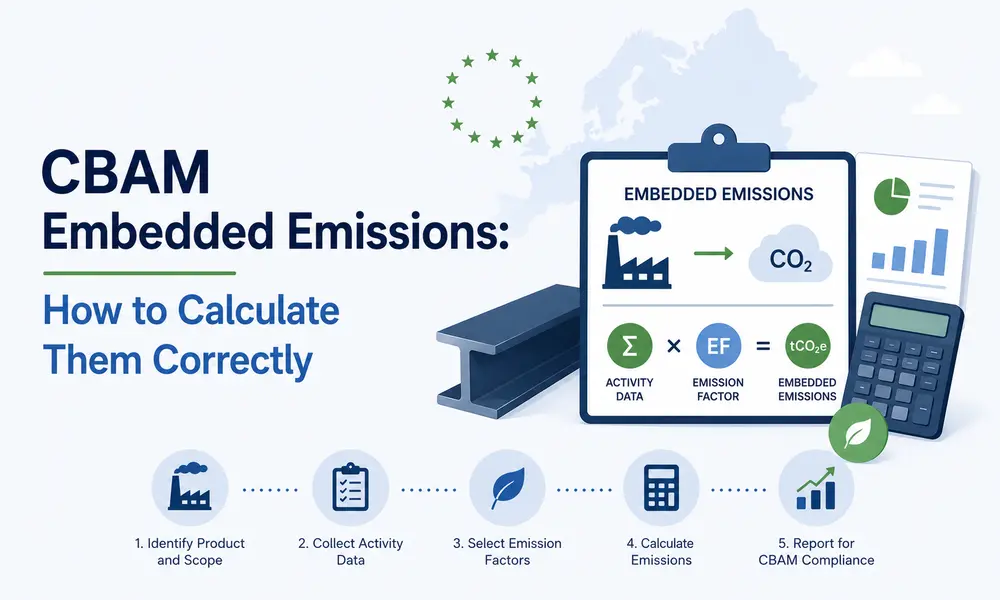
The calculation methodology for the definitive period is detailed in Implementing Regulation (EU) 2025/2547. In practice, the process follows a consistent sequence regardless of sector:
- Identify the CBAM good, its CN code and the relevant production route.
- Define the functional unit and reporting period for the specific embedded emissions figure.
- Collect activity data: fuel consumption, process inputs, electricity use and output quantities.
- Identify all precursor materials and obtain their embedded emissions, actual or default.
- Apply the monitoring methodology to calculate direct emissions from the production process.
- Add indirect electricity emissions where the applicable rules require this, where applicable.
- Combine direct, indirect and precursor emissions, then divide by the functional unit output.
- Document assumptions, data sources and any default values used for the declaration file.
Worked Example or Decision Framework
The following figures are illustrative only and simplify a real production process for demonstration purposes.
Assume a steel producer reports one production route, one functional unit (tonnes of crude steel), no co-products, and full attribution of stated emissions to the reported output. Direct process emissions are 1.6 tCO2e per tonne of crude steel. The pig ore precursor contributes a further 0.4 tCO2e per tonne, based on supplier-reported actual data. No indirect electricity emissions apply under current guidance for this good category. The specific embedded emissions total is therefore 2.0 tCO2e per tonne of crude steel, calculated by summing direct and precursor emissions and dividing by the functional unit output — with no adjustment for consignment size, since the calculation boundary is the production process, not the shipment.
How ISO 14067 Product Data Feeds CBAM Declarations
Non-EU producers increasingly hold product carbon footprint data prepared under ISO 14067. This standard is a useful starting point for CBAM purposes because it already structures activity data by product and production stage. However, an ISO 14067 result is not directly insertable into a CBAM declaration. System boundaries, functional units and allocation rules differ between the two frameworks and must be mapped and recalculated against the CBAM monitoring methodology before use. In practice, this means re-checking which processes are included, how co-products are allocated, and whether the functional unit matches the CBAM requirement. Producers who already run PCF assessments under our carbon accounting support are typically better placed to supply CBAM-ready figures to their EU importers.
Verification and Evidence Requirements
Verification and accreditation rules for the definitive period appear in Implementing Regulation (EU) 2025/2546. Formal third-party verification applies where actual values are declared, confirming that installation-specific data has been correctly measured and reported. Default-value declarations do not involve verification of installation-specific actual data, since no site-specific figures are being claimed. We are consultants, not an accredited verification body — verification itself is carried out by independent third-party verifiers under this framework.
Common Calculation Mistakes
Several recurring errors distort embedded emissions figures. Declarants often omit precursor emissions entirely, treating the final production step as the whole boundary. Others apply the wrong functional unit, particularly for cement and fertiliser products subject to specialised unit rules. Confusing consignment size with the production calculation boundary is another frequent issue. Some importers also insert ISO 14067 figures directly without remapping system boundaries, or fail to document which default values were used and why, weakening audit readiness.
How We Work and What You Receive
Our approach starts with mapping your supply chain against CBAM applicability and identifying which goods and precursors require data. We then work with your suppliers or internal engineering teams to gather activity data, apply the monitoring methodology, and decide where actual values are feasible versus where default values under 2025/2621 are appropriate. Clients receive a structured embedded emissions calculation file, precursor documentation, and a decision log explaining actual-versus-default choices — ready for your authorised CBAM declarant to use in the annual declaration. This work connects to our broader support on CBAM definitive phase 2026 obligations and to ISO-aligned certification support services.
Frequently Asked Questions
Do all CBAM goods use the same functional unit?
No. Tonnes of CO2e per tonne of goods is the common approach, but certain cement and fertiliser products follow specialised rules set in the implementing regulations.
Can we mix actual and default values for one product?
For complex goods, actual data for the main process can sometimes be combined with default values for individual precursors, where permitted by the applicable rules.
Is indirect electricity always included?
No. It applies where the methodology requires it, currently including cement, fertilisers and agglomerated iron ore, where applicable, based on current Commission guidance available via the official CBAM legislation and guidance page.
How does CBAM relate to the EU ETS?
CBAM certificate prices are linked to EU ETS auction price averages; background on the underlying trading system is available on the European Commission’s EU ETS page and in our summary of the EU Emissions Trading Directive.
Who submits the CBAM declaration?
The authorised CBAM declarant submits the annual declaration, covering 2026 imports by 30 September 2027, together with certificate surrender.
Request a CBAM Embedded Emissions Assessment
If your team needs a structured, audit-ready approach to calculating specific embedded emissions across your CBAM-covered goods, we can help you build the data, documentation and decision framework your declarant requires. Contact Zero Emissions Hub to request an assessment or call +359 889 537 131 to discuss your supply chain.
OUR SERVICE OFFERINGS
Carbon Accounting and ESG Reporting Services
Carbon Footprint Assessment
Accurately measure and analyze your organization’s carbon emissions to identify reduction opportunities and improve sustainability.
Sustainability Strategy Development
Craft a robust sustainability strategy that aligns with your business goals and regulatory requirements, driving long-term value.
Ways to Achieve Carbon Neutrality with Zero Emissions Hub
Our team is ready to assist you with tailored solutions to meet your sustainability goals.
Product Carbon Footprint Calculation

CBAM Reporting Carbon Emissions

ESG Report Preparation and Presentation

Get in Touch with Zero Emissions Hub
Reach out to us for expert guidance on carbon accounting and ESG reporting. Our team is ready to assist you with tailored solutions to meet your sustainability goals.
Phone
(359) 889-537-131
contact@zeroemissionshub.com
Address
Mladost 1A, 9 Anna Ahmatova Str., Sofia, 1000
Contact Form
Offices
Sofia
Mladost 1A, 9 Anna Ahmatova Str.
Plovdiv
16 Georgi Valkovich Str.
Varna
90 Tsar Osvoboditel Blvd.
Find More Similar Aricles
CBAM Certificate Costs Explained: How to Forecast Your 2026 Exposure
CBAM certificate cost is quickly becoming a real budget line, not a theoretical compliance topic. From 2026, importers of iron, steel, aluminium, cement, fertilisers, hydrogen and electricity into the EU must buy certificates matching the embedded emissions in their...
CBAM Definitive Phase 2026: What EU Importers Must Do Now
CBAM definitive phase 2026 marks the point where reporting obligations turn into financial ones. Until now, importers only had to report embedded emissions data. From 2026, they will need to…

CBAM Registration Declarant EU: How to Become an Authorised CBAM Declarant
For many importers, the big CBAM question is no longer “does this apply to us?” but “how do we actually register as an authorised CBAM declarant in the EU?”This article brings together the key points from Zero Emissions Hub’s CBAM Mechanism for Carbon Border...