
CBAM Registration Declarant EU: How to Become an Authorised CBAM Declarant
For many importers, the big CBAM question is no longer “does this apply to us?” but “how do we actually register as an authorised CBAM declarant in the EU?”This article brings together the key points from Zero Emissions Hub’s CBAM Mechanism for Carbon Border Adjustment – Requirements guide and its specialised CBAM Reporting Carbon Emissions services, so you can understand what CBAM registration really involves – and how to prepare.

What Is CBAM and Why Does Declarant Registration Matter?
CBAM is the EU’s carbon border price adjustment tool under the Green Deal and Fit for 55 package. It places a carbon cost on imports of high-emission goods (cement, iron and steel, aluminium, fertilisers, hydrogen and electricity) so that they face a comparable carbon price to production inside the EU ETS.
CBAM is being rolled out in two phases:
Transitional phase (1 October 2023 – 31 December 2025)
Importers submit quarterly CBAM reports through the transitional registry but do not yet surrender CBAM certificates.
Operational phase (from 1 January 2026 onward)
CBAM becomes fully operational: importers have to purchase and surrender CBAM certificates annually, based on the embedded emissions in imported goods.
From 2026, the system is built around authorised CBAM declarants. They are the only ones allowed to import CBAM goods and to use the CBAM registry to hold certificates, file annual declarations and benefit from any carbon price deductions for third-country schemes.
Who Needs CBAM Registration as an Authorised Declarant in the EU?
Zero Emissions Hub’s CBAM guide explains that any importer bringing CBAM-covered goods into the EU is already subject to reporting obligations in the transitional period.
With the amendments introduced by Regulation (EU) 2025/2083, a new “single mass-based threshold” of 50 tonnes per year has been created:
If your total annual imports of CBAM goods remain below 50 tonnes, you benefit from a de minimis exemption and are not subject to CBAM obligations for that year (except for some categories such as electricity and hydrogen).
If you expect to exceed the 50-tonne threshold, you are expected to apply in advance for authorised CBAM declarant status.
The rules apply not only to importers acting in their own name, but also to indirect customs representatives who take on CBAM responsibilities. They must obtain authorisation themselves before acting as CBAM declarants.
In other words, if you’re an EU-based importer of CBAM goods – or a customs broker who wants to act as a CBAM declarant – CBAM registration is not optional once you cross that threshold.
Key Legal Requirements for CBAM Declarant Registration
The Zero Emissions Hub CBAM page summarises the legal requirements for becoming an authorised CBAM declarant in the definitive system.
Eligibility Criteria for Authorised CBAM Declarants
To obtain authorised status, an applicant must:
Be established in an EU Member State.
Hold a valid EORI number (Economic Operators Registration and Identification).
Demonstrate financial and operational capacity to comply with CBAM (including purchasing certificates, managing data and dealing with verification).
Have a clean customs and tax compliance record, meaning no serious violations.
Applications are submitted to the national competent authority, which must generally decide within 15 working days.
Ongoing Responsibilities After Registration
Once registered, authorised CBAM declarants are responsible for much more than a one-off form:
Maintaining records for at least four years.
Submitting annual CBAM declarations that include verified embedded emissions.
Purchasing and surrendering CBAM certificates by statutory deadlines (currently end-September of the following year).
Co-operating with accredited verifiers and audits.
Notifying authorities of changes in company structure, import patterns or production sources.
Declarants also need to understand how carbon price deductions work when a carbon price has already been paid in a third country – and under which conditions these deductions are allowed.
The CBAM Registry: From Transitional Reporting to the Definitive System
Zero Emissions Hub’s CBAM analysis distinguishes clearly between the transitional registry and the more advanced definitive CBAM registry.
Transitional CBAM Registry (2023–2025)
Implementing Regulation (EU) 2023/1773 sets up the CBAM transitional registry and defines what must be reported quarterly. CBAM “reporting declarants” (importers and authorised filers) submit data such as:
quantities and CN codes of imported goods;
country of origin and production installations;
embedded direct and indirect emissions;
calculation methods and emission factors used.
This phase is a learning and data-gathering period with no certificate surrender, but it builds the baseline for the 2026 system.
Definitive CBAM Registry (From 2026 Onward)
Implementing Regulation (EU) 2024/3210 governs the technical implementation of the definitive CBAM registry, covering:
the IT architecture and data security of the registry;
interoperability with EU customs systems, so customs data flows into CBAM accounts;
user access and identity verification for declarants, operators and verifiers.
From 2026, authorised CBAM declarants use this registry to:
hold and manage CBAM certificates;
lodge annual CBAM declarations;
link verified emissions data from third-country operators;
ensure that delegated third parties (such as service providers) have controlled access.
Practical Steps to Prepare for CBAM Registration Declarant EU
Even before you submit a formal application, there is a lot you can do to make CBAM registration smoother:
- Map your CBAM-covered imports
- Identify all products in the CBAM sectors (iron and steel, cement, aluminium, fertilisers, hydrogen and electricity).
- Confirm CN codes and annual tonnages to see whether you will exceed the 50-tonne de minimis threshold.
- Clarify roles with customs representatives
- Decide whether you will act as the authorised CBAM declarant yourself or whether an indirect customs representative will take on that role.
- Make sure any representative understands they must also obtain CBAM authorisation if they carry declarant responsibilities.
- Prepare the documentation for registration
- Evidence that you are established in an EU Member State.
- Your EORI number.
- Basic proof of financial and operational capacity, such as internal CBAM procedures or existing compliance systems.
- Strengthen emissions data and verification workflows
- Use your existing carbon accounting processes to collect reliable embedded emissions data for producers.
- Align your methods with the options described in the CBAM transitional rules (activity-based methods, CEMS, or recognised alternative methodologies) so that your numbers are verifier-ready by 2026.
- Build an internal CBAM governance model
- Assign clear responsibilities for CBAM reporting, certificate strategy and contact with competent authorities.
- Integrate CBAM into your broader EU ETS and ESG compliance roadmap – Zero Emissions Hub’s ETS and reporting guides show how these frameworks fit together.
How Zero Emissions Hub Supports CBAM Registration, Reporting and Verification
Zero Emissions Hub combines deep expertise in EU ETS, CBAM and RED and specialises in turning complex regulation into clear, operational steps for importers and their advisors.
On the CBAM Reporting Carbon Emissions service page, the team outlines several ways they support declarants:
Comprehensive CBAM compliance support – aligning your product emissions data with Regulation (EU) 2023/956.
Quarterly CBAM reporting support – managing the full data chain from CN codes to emissions calculations.
Transitional registry management – helping you gain and manage access, format submissions and delegate access to customs brokers.
Verification and documentation – preparing you for the 2026 requirement for accredited verification and attaching verifier reports to annual declarations.
CBAM certificate advisory (from 2026 onward) – estimating certificate needs and avoiding penalties or over-purchasing.
De minimis and special case analysis – confirming whether you qualify for the <50-tonne exemption and documenting this correctly in customs forms.
If you prefer not to build an internal CBAM team from scratch, you can also combine CBAM support with broader carbon accounting and ESG reporting packages, ensuring that CBAM is fully integrated into your climate and regulatory strategy.
OUR SERVICE OFFERINGS
Carbon Accounting and ESG Reporting Services
Carbon Footprint Assessment
Accurately measure and analyze your organization’s carbon emissions to identify reduction opportunities and improve sustainability.
Sustainability Strategy Development
Craft a robust sustainability strategy that aligns with your business goals and regulatory requirements, driving long-term value.
Ways to Achieve Carbon Neutrality with Zero Emissions Hub
Our team is ready to assist you with tailored solutions to meet your sustainability goals.
Product Carbon Footprint Calculation

CBAM Reporting Carbon Emissions

ESG Report Preparation and Presentation

Get in Touch with Zero Emissions Hub
Reach out to us for expert guidance on carbon accounting and ESG reporting. Our team is ready to assist you with tailored solutions to meet your sustainability goals.
Phone
(359) 889-537-131
contact@zeroemissionshub.com
Address
Mladost 1A, 9 Anna Ahmatova Str., Sofia, 1000
Contact Form
Offices
Sofia
Mladost 1A, 9 Anna Ahmatova Str.
Plovdiv
16 Georgi Valkovich Str.
Varna
90 Tsar Osvoboditel Blvd.
Find More Similar Aricles
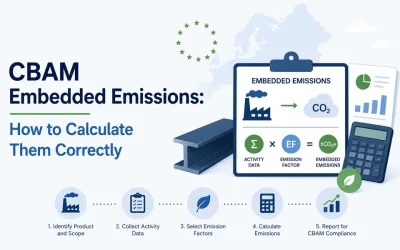
CBAM Embedded Emissions: How to Calculate Them Correctly
CBAM embedded emissions are the greenhouse gas emissions released during the production of goods covered by the EU Carbon Border Adjustment Mechanism. Getting this number right is not a formality….
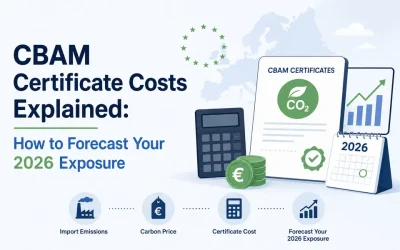
CBAM Certificate Costs Explained: How to Forecast Your 2026 Exposure
CBAM certificate cost is quickly becoming a real budget line, not a theoretical compliance topic. From 2026, importers of iron, steel, aluminium, cement, fertilisers, hydrogen and electricity into the EU must buy certificates matching the embedded emissions in their...
CBAM Definitive Phase 2026: What EU Importers Must Do Now
CBAM definitive phase 2026 marks the point where reporting obligations turn into financial ones. Until now, importers only had to report embedded emissions data. From 2026, they will need to…
0 Comments