
CBAM Certificate Costs Explained: How to Forecast Your 2026 Exposure
CBAM certificate cost is quickly becoming a real budget line, not a theoretical compliance topic. From 2026, importers of iron, steel, aluminium, cement, fertilisers, hydrogen and electricity into the EU must buy certificates matching the embedded emissions in their goods. Finance teams are asking a simple question: how much will this actually cost us next year? At Zero Emissions Hub, we help importers, manufacturers and their advisers answer that question with real numbers, not guesswork.
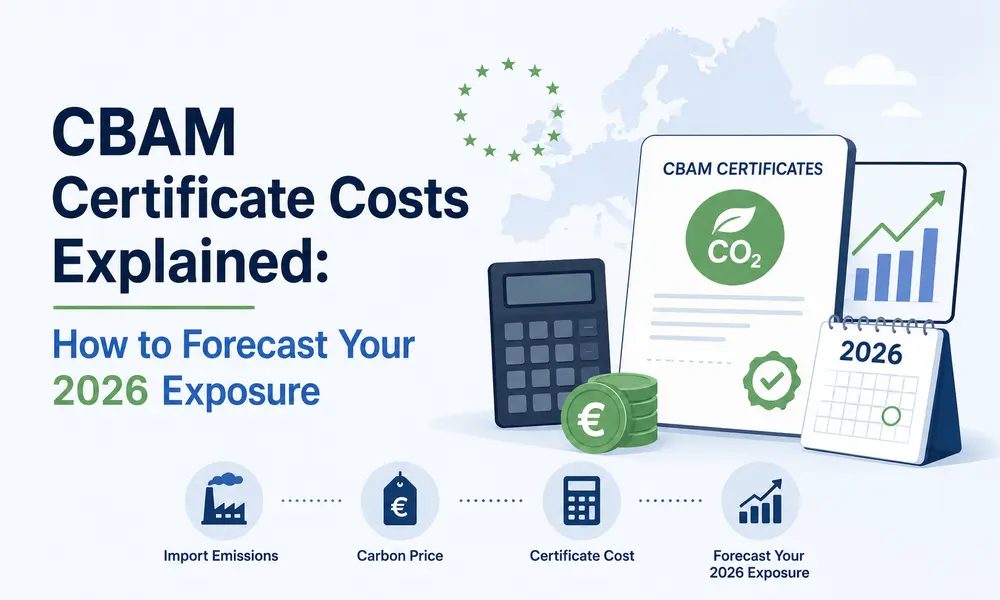
CBAM certificate cost: what you are actually paying for
Each CBAM certificate represents one tonne of CO2e embedded in imported goods. The price tracks the weekly average auction price of EU ETS allowances. That means your CBAM certificate cost moves with carbon market volatility, not with a fixed government fee. If ETS prices rise, your exposure rises too, even if your import volumes stay flat.
The number of certificates you owe depends on two things: quantity imported and embedded emissions per tonne of product. Get the emissions data wrong, and the cost forecast collapses. This is why supplier data quality matters as much as the carbon price itself.
Some free allocation adjustments apply during the transition, reducing the certificates you need to surrender. But these reductions phase out gradually through the mid-2030s. Planning today means understanding both the price curve and the shrinking free allocation cushion.
CBAM certificate cost drivers for 2026: price, benchmarks and embedded emissions
Three variables drive your final bill. First, the EU ETS carbon price, which has fluctuated significantly over recent years. Second, the default emission values published by the European Commission, used when supplier-specific data is missing. Third, actual verified emissions data from your suppliers, which usually differs from defaults.
Default values are often set conservatively high. Suppliers without proper carbon accounting systems in place tend to push your cost estimates upward. This is a strong commercial reason to ask suppliers for verified, ISO-aligned emissions data rather than relying on EU defaults.
Product mix matters too. A tonne of primary aluminium carries a very different emissions profile than a tonne of finished steel components. Your forecasting model needs product-level granularity, not just a single blended average across your import portfolio. Our CBAM reporting support helps clients build that granularity into their systems.
How to forecast your 2026 exposure step by step
Start with your import volumes by CN code, broken down monthly if possible. Seasonal shipping patterns can shift your quarterly exposure more than people expect. Next, map each product line against available supplier emissions data, noting where gaps still exist.
Where supplier data is missing or unverifiable, apply default values as a placeholder, then flag those lines for follow-up. This gives you a realistic worst-case scenario alongside a best-case one built on verified data. Compliance officers and finance teams should see both numbers side by side.
Run sensitivity analysis against EU ETS price scenarios. What happens if allowance prices rise 20 percent by mid-2026? What if they fall? Building a range, rather than a single point estimate, helps procurement and finance plan working capital more accurately. This step alone often changes sourcing decisions well before certificates become mandatory.
It also helps to understand how CBAM fits within the broader EU Carbon Adjustment Mechanism framework, since reporting obligations and certificate rules are closely linked. Many clients also find it useful to align this work with existing CSRD reporting timelines, since emissions data often overlaps across both regimes.
Reducing your CBAM certificate cost through better data and decarbonisation
Better data almost always means a lower bill. Suppliers with verified, product-level carbon footprints, aligned with ISO 14067 product carbon footprint methods, tend to report lower actual emissions than EU default values. Switching to actual data instead of defaults can meaningfully reduce your certificate obligation.
Decarbonisation in your supply chain has a direct financial payoff under CBAM. Lower embedded emissions per tonne translate into fewer certificates required, not just a reputational benefit. This is a rare case where sustainability performance and finance metrics point in exactly the same direction.
Reviewing supplier contracts now, before 2026 enforcement begins, gives you leverage to request emissions data as a contractual condition. Waiting until certificates are mandatory leaves far less negotiating room. Our team supports clients through this transition as part of our carbon accounting and ESG reporting packages, combining CBAM data work with wider Scope 3 emissions mapping.
For background on the regulation itself, the European Commission’s official CBAM page is a useful reference point for legal text and updates. We track these updates closely and reflect them in the guidance we give clients across sectors covered by the mechanism.
Curious about how CBAM interacts with your existing ESG disclosures? Our blog covers related topics including Scope 3 emissions, CSRD readiness and product carbon footprint calculations. Visit our homepage to see the full range of services we offer to importers and manufacturers preparing for 2026.
Get tailored guidance on your CBAM certificate cost exposure
Forecasting your 2026 CBAM certificate cost accurately takes proper data, not assumptions. Our team at Zero Emissions Hub combines carbon accounting expertise with finance-grade precision to help you build a defensible forecast. Call us at +359 889 537 131 or use our contact form to schedule a call and start preparing your exposure model today.
OUR SERVICE OFFERINGS
Carbon Accounting and ESG Reporting Services
Carbon Footprint Assessment
Accurately measure and analyze your organization’s carbon emissions to identify reduction opportunities and improve sustainability.
Sustainability Strategy Development
Craft a robust sustainability strategy that aligns with your business goals and regulatory requirements, driving long-term value.
Ways to Achieve Carbon Neutrality with Zero Emissions Hub
Our team is ready to assist you with tailored solutions to meet your sustainability goals.
Product Carbon Footprint Calculation

CBAM Reporting Carbon Emissions

ESG Report Preparation and Presentation

Get in Touch with Zero Emissions Hub
Reach out to us for expert guidance on carbon accounting and ESG reporting. Our team is ready to assist you with tailored solutions to meet your sustainability goals.
Phone
(359) 889-537-131
contact@zeroemissionshub.com
Address
Mladost 1A, 9 Anna Ahmatova Str., Sofia, 1000
Contact Form
Offices
Sofia
Mladost 1A, 9 Anna Ahmatova Str.
Plovdiv
16 Georgi Valkovich Str.
Varna
90 Tsar Osvoboditel Blvd.
Find More Similar Aricles
CBAM Embedded Emissions: How to Calculate Them Correctly
CBAM embedded emissions are the greenhouse gas emissions released during the production of goods covered by the EU Carbon Border Adjustment Mechanism. Getting this number right is not a formality….
CBAM Definitive Phase 2026: What EU Importers Must Do Now
CBAM definitive phase 2026 marks the point where reporting obligations turn into financial ones. Until now, importers only had to report embedded emissions data. From 2026, they will need to…

CBAM Registration Declarant EU: How to Become an Authorised CBAM Declarant
For many importers, the big CBAM question is no longer “does this apply to us?” but “how do we actually register as an authorised CBAM declarant in the EU?”This article brings together the key points from Zero Emissions Hub’s CBAM Mechanism for Carbon Border...